Budget 2026: What It Means for Movers and Landlords
Chancellor John Healey delivered his first Budget this afternoon, 28 October. If you were hoping for a stamp duty cut, there was not one. If you are a landlord, there was a tax rise. And if you are a first-time buyer, there is a new scheme on the way, but not until next year.
Here is what was actually announced, what it means in pounds and pence, and what buyers, sellers, landlords and tenants in Bramhall, Cheadle Hulme and the wider SK7 and SK8 area should do about it.
The headlines in 60 seconds
Stamp duty: no change. Rates stay exactly as they are.
Landlords: tax on rental income goes up by a further two percentage points from April 2027, to 24%, 44% and 49% depending on your tax band (The Negotiator, Propertymark).
First-time buyers: a new Your First Home equity loan scheme for new-build homes, with a 2.5% minimum deposit, launching in 2027 (Propertymark).
Tenants: confirmation that renters in England will not pay stamp duty on rent under the new assured tenancies (Propertymark).
Savers: a new First Time Buyer ISA from April 2029, and a lower Lifetime ISA withdrawal penalty from 29 October 2026 (The Negotiator).
The forecast: the Office for Budget Responsibility expects house prices to rise around 2% this year and 2.5% in 2027, with the average mortgage rate people actually pay climbing from 4% to about 5% by 2031 (Propertymark, reporting the OBR).
Stamp duty: nothing has changed
The Prime Minister ruled out stamp duty changes back in July, and the Chancellor stuck to that. Mortgage Strategy reports that stamp duty was left completely untouched despite it topping the industry's wish list.
For reference, these are the rates for homes in England, in place since 1 April 2025 (GOV.UK):
Up to £125,000: 0%
£125,001 to £250,000: 2%
£250,001 to £925,000: 5%
£925,001 to £1.5 million: 10%
Above £1.5 million: 12%
First-time buyers pay 0% on the first £300,000 and 5% on the portion between £300,001 and £500,000. Above £500,000 the relief does not apply. Anyone buying an additional property, such as a buy-to-let, pays a 5% surcharge on top.
What that means locally
Using Rightmove's average sold prices for the last twelve months:
A Cheadle Hulme semi at £388,977: £4,449 for a first-time buyer, or £9,449 for a home mover.
A Bramhall semi at £464,795: £8,240 for a first-time buyer, or £13,240 for a home mover.
Our take: if you were waiting to see whether stamp duty would be cut before you moved, you now have your answer. There is no reason to hold off on that account.
Landlords: a second rise in tax on rental income
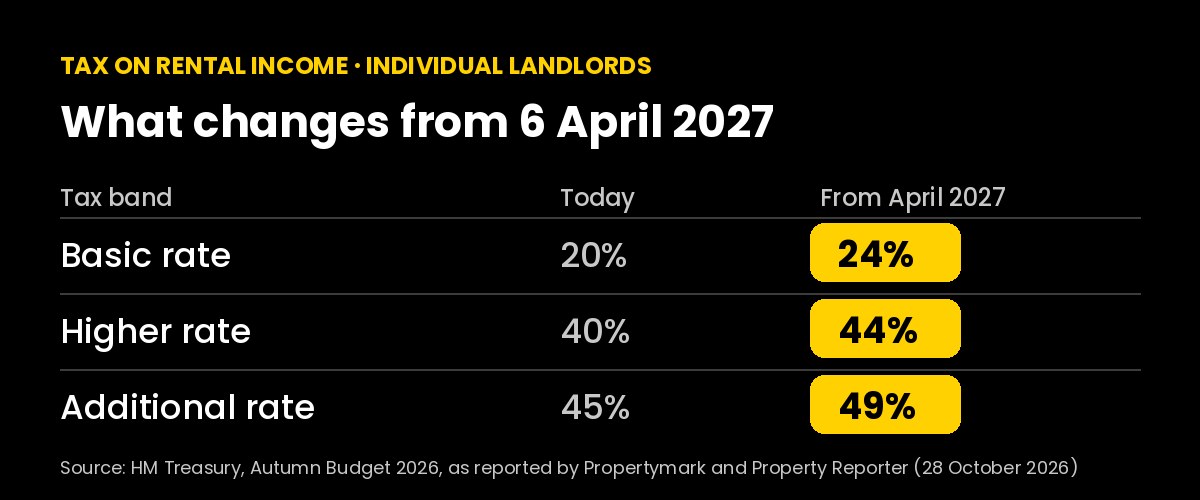
This is the measure with the biggest impact locally. Last year's Budget had already set separate, higher tax rates for property income from April 2027: 22%, 42% and 47%. Today the Chancellor added a further two percentage points on top, so from 6 April 2027 rental profits will be taxed at:
Basic rate: 20% today, 24% from April 2027
Higher rate: 40% today, 44% from April 2027
Additional rate: 45% today, 49% from April 2027
Source: Property Reporter and Propertymark, 28 October 2026. The rates apply to individual landlords, not companies. Tax on dividends and employment income is unchanged.
What it looks like in pounds
Our own illustration, not advice: a landlord with £12,000 of rental profit a year who pays basic-rate tax currently pays £2,400 on it. At 24%, that becomes £2,880, an extra £480 a year, or about £40 a month. A higher-rate taxpayer with the same profit would also pay around £480 more. Your own position will depend on your other income, mortgage interest and allowable expenses, so speak to your accountant.
One small positive buried in the detail: the tax credit for mortgage interest moves with the basic property rate, so it rises to 24% as well, according to Property Reporter.
The Government's own Budget document says 84% of income taxpayers will be unaffected and that around half the extra revenue will come from the top 10% of households (Property Reporter). The industry is less relaxed. Timothy Douglas of Propertymark called it a steep and punitive rise that will discourage new landlords, and Heather Powell of accountants Blick Rothenberg warned it will push some private landlords to sell, reducing supply and pushing rents up (The Negotiator).
What we would say to local landlords
Do not sell on a headline. The change does not start until April 2027, and demand for rented homes in Stockport is strong: the ONS puts average private rents in Stockport at £1,119 a month in August 2026, up 5.4% on a year earlier.
Review the numbers now. Check your rent is at market level, make sure you are claiming every allowable expense, and ask your accountant whether your current set-up still makes sense.
Remember the landlord register opens on 15 December. We covered it in our landlord guide.
Get a rental valuation. If you want an honest view of what your property should be achieving, our lettings team in Bramhall and Cheadle Hulme will tell you.
First-time buyers: Your First Home
The Budget confirmed the details of Your First Home, a £4.7 billion scheme to help first-time buyers into new-build homes. According to Propertymark's summary:
a Government equity loan of 20% of the price, interest-free for five years
a deposit of between 2.5% and 15%
household income limits of £110,000 outside London
price caps based on local median house prices
pre-registration by the end of December 2026, applications from February 2027 and the first loans from April 2027
Zoopla's Richard Donnell estimates up to 30,000 first-time buyers a year could benefit and that over a third of new homes could qualify (The Negotiator). Note that it is for new-build homes only, so it will not help if you have your eye on a Victorian terrace in Cheadle Hulme. We will share the local price cap for Stockport as soon as it is published.
Alongside it, a new First Time Buyer ISA launches in April 2029, allowing savings of up to £4,000 a year with a 25% Government bonus on homes up to £450,000. From tomorrow, 29 October, anyone using a Lifetime ISA to buy above the £450,000 cap pays a reduced 20% withdrawal charge instead of the old 25% (The Negotiator).
Mortgages: the bigger story is still rates
The Budget did little directly for mortgage costs, and that is what most buyers and remortgagers will feel. Mortgage Strategy reported on Budget morning that the average new mortgage rate had risen to 5.88%, citing Moneyfacts. The OBR now expects the average rate borrowers actually pay to rise from 4% in 2026 to around 5% by 2031 as people roll off cheaper fixed deals (The Intermediary, reporting the OBR).
The next Bank of England decision is on 5 November. If your fixed deal ends in the next six months, our advice is unchanged from our mortgage rates update: secure a rate now, and switch if something better appears before completion.
Looking to borrow a different amount?
Why not try our mortgage calculator and then book to see what exclusive deals we can get you.

Also in the Budget
Household Energy Payment: a £100 payment for homes in council tax bands A to D in England from January 2027, and the VAT cut on domestic electricity runs until 1 July 2027 (Propertymark).
Social and affordable homes: an extra £1.5 billion for the Social and Affordable Homes Programme, supporting about 10,000 homes, and zero VAT on land sold to registered social housing providers from April 2027 (Propertymark, Property Week).
£2 million homes: the High Value Council Tax Surcharge goes ahead, with first bills due in March 2028. Very few homes in SK7 and SK8 will be affected (The Negotiator).
Building rules: no major new building regulations for the rest of this Parliament, except where safety requires (Propertymark).
What it means for you
Buying? Stamp duty is unchanged, so no reason to wait. Your mortgage rate matters far more than anything in today's speech, so get advice before you make an offer.
Selling? Nothing in the Budget changes the fundamentals: there are more homes on the market than for years, so realistic pricing and good presentation win. If you own a buy-to-let you were already thinking of selling, a valuation now will help you plan the timing.
Letting? Plan for higher tax from April 2027, but do not panic. Strong local rental demand means well-managed properties remain a sound long-term investment.
Renting? The confirmation that you will not pay stamp duty on your rent removes a worry that had been raised after the Renters' Rights Act. Longer term, keep an eye on rents, as landlords' costs tend to filter through.
Talk to our Bramhall or Cheadle Hulme team
Thinking of selling or letting? Book a free valuation or lettings appraisal with our Bramhall or Cheadle Hulme office.
Buying, moving or remortgaging? Get mortgage advice to find out what you can borrow and what it will cost before the Bank of England meets on 5 November.

For any other enquiry, email [email protected].
This article is general information, not financial or tax advice. Budget measures are subject to the detail in the Finance Bill. Your home may be repossessed if you do not keep up repayments on your mortgage.
Sources: HM Treasury Autumn Budget 2026 as reported by Propertymark, "Budget 2026 raises landlord taxes as new support targets first-time buyers" (28 October 2026); The Negotiator, "Autumn Budget 2026: What did Chancellor Healey announce for the housing market?" (28 October 2026); Property Reporter, "Budget 2026: landlords dealt property income tax blow" (28 October 2026); Property Week (28 October 2026); Mortgage Strategy, "Chancellor ignores calls for stamp duty reform" and Moneyfacts data (28 October 2026); The Intermediary, reporting the OBR Economic and Fiscal Outlook (28 October 2026); GOV.UK stamp duty land tax rates (from 1 April 2025); Rightmove sold prices (last 12 months); Office for National Statistics, private rents in Stockport (August 2026).